Ketton Village – Orange Route
1 mile (1.6 km)
Ketton is a village of limestone buildings and magnificent trees. With its linked hamlets of Aldgate and Geeston, Ketton has over 100 stone buildings of architectural or historic interest that are scheduled Grade II Listed buildings, mainly built over the last 300 years. Many of the buildings are described on the Ketton Village History site. Due to Thomas Burroughes the village also has many mature and unusual trees which are described on the village Tree Trails.
1 Ketton Library
This short walk begins at the library building also known as the Ketton Hub. It is faced with limestone from the former village school which was built in 1857 and where pupils paid one penny a week to attend. Ketton limestone has been quarried in the parish since the Middle Ages. It is a “freestone” as it can be worked in any plane having been laid down in a calm Jurassic sea. The School House next to the Library has an arched door, which before 1857 was part of an earlier school. The school was enlarged in 1902 and completely rebuilt in 1969.
2 Stock’s Hill
Walk west for a few yards towards the village square.
Stock’s Hill was the site of the village stocks, but now has the Queen Victoria Jubilee Fountain which was erected in 1887. The Fountain had an adjacent horse trough that also replenished steam engines. This small area was the centre of the village with cobblers, blacksmiths, bakeries, hairdressers and butchers shops surrounding the fountain and also had a flagpole now reinstated. The small Bier House behind the brick wall once housed the bier or trolley, used to carry coffins to the church and on to the cemetery. Two large water tanks in the roof fed the fountain for animals to drink and steam engines to fill their boilers.

3 Redmiles Lane
Keep left towards Redmiles Lane.
Buckworth House built in 1741 is beautifully faced with Ketton stone. If you carry on to the bottom of the lane this is where the Redmile family lived in the farmhouse. It also leads to Hall Close, the public recreation ground and the former Parish Workhouse which closed in 1836. Many of the stone houses are roofed in Collyweston slates. These lovely frost-split slates have been extracted from shallow mines at Collyweston and Easton on the Hill just across the Welland Valley from Ketton. (If you have walked to the end of Redmiles Lane, retrace your steps to the public footpath sign at the top of the lane).
4 St Mary’s Church
At the public footpath signpost, turn right down an alley known as The Bricks leading to the church. At the end of The Bricks turn left into the churchyard.
The parish church of St Mary the Virgin is an exceptionally fine building. It is surprisingly built of Barnack stone rather than Ketton stone, as Peterborough diocese owned the Barnack quarries. The earliest part of the building is the richly carved west doorway which dates from about 1190 – an example of the merging of Norman into Gothic, or Early English, architecture. The 13th century tower and spire looms 50m into the sky, pierced on each side by a delicate window, and the 14th century spire, with three tiers of dormer windows, are also magnificent, especially when floodlit. The six bells are only chimed and never rung because of the weakness of the tower. The churchyard has an interesting collection of gravestones carved from Ketton stone by Ketton stonemasons, such as the one for the Hibbins family next to the church lych-gate. A lych-gate is a roofed gateway to a churchyard, formerly used at burials for sheltering a coffin until the clergyman’s arrival.
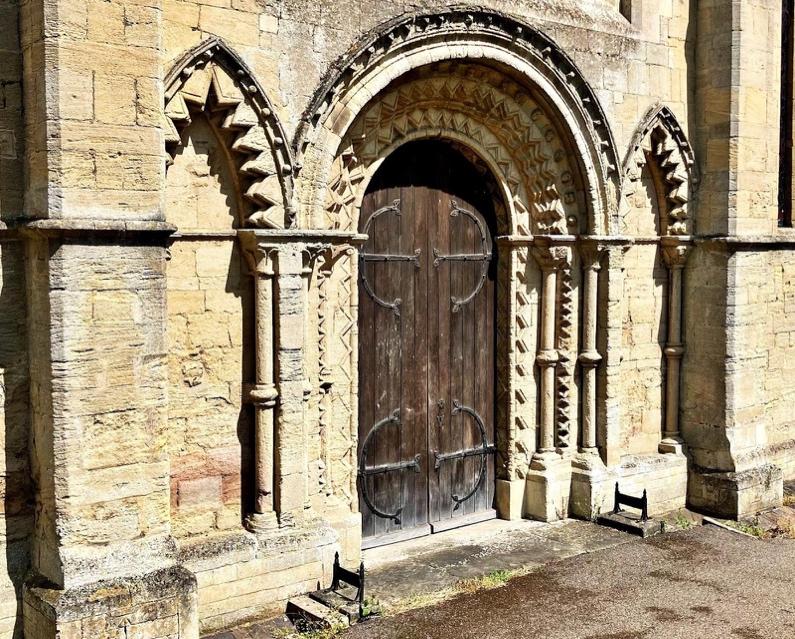
5 Church Road
Turn left at the front of the church.
The views along Church Road are some of the best to be seen in any English village. Features include the Railway Inn, the wooden lych-gate, the church, the Vicarage, Garden Cottage and the extended buildings of the Priory with its magnificent ashlar stone dovecote. Old dovecotes, also known as pigeon houses or culverhouses, were structures built to house pigeons for meat, eggs and fertiliser, and were a symbol of status and wealth. The oldest building is Garden Cottage on the church side of the bridge. It was built as the vicarage in 1629 to be replaced in 1820 by the larger house after the church, which remained a vicarage until 1974.
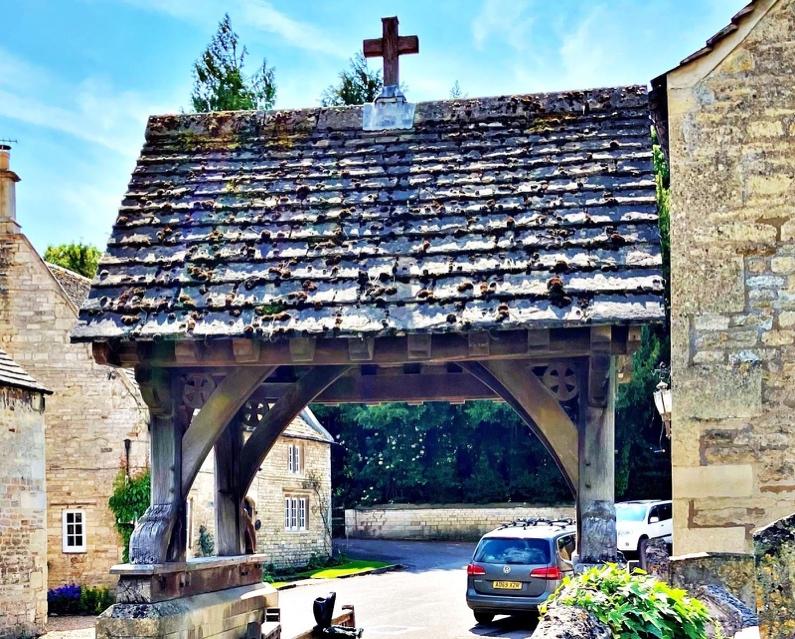
6 Church Road Bridge
Cross the wooden footbridge over the river.
The village has a huge variety of unusual and special trees – spot the Yew tree with its climbing Wisteria outside Garden Cottage, and the five huge evergreen Giant Sequoias (or Wellingtonias). All the fifty Sequoias around the parish were planted by Thomas Burroughes over 100 years ago but they could possibly live for another 3,000 years! The River Chater, giving its name to Ketton, flows towards Tinwell where it joins the River Welland. The 17th century bridge here consists of one built over another. The first was a pack horse bridge, supplemented with a ford, and the second, with three arches, was widened in 1849 and inscribed with R.H. for Robert Hibbins, one of the famous Ketton stonemasons. Limited car parking is possible near the bridge.
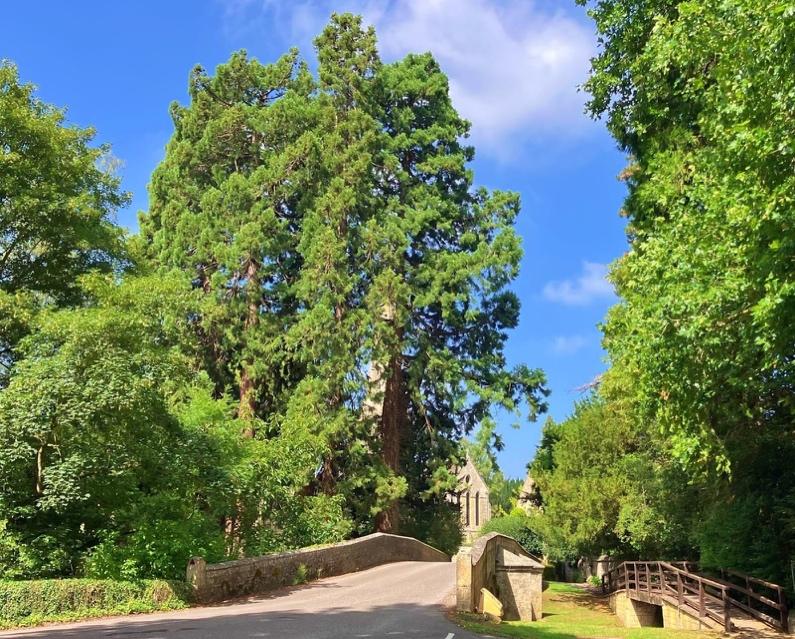
7 Aldgate Lodge
Carry straight on past Aldgate Lodge and then turn left into Aldgate.
The entrance to Aldgate Lodge is flanked by two large Plane trees with their bobble-like fruit. These were planted in 1935 for the silver wedding of Charlie and Katie Burroughes, whose father lived there and planted many of the trees in the village. Opposite Aldgate Lodge is a footpath to Sooty Bridge and Geeston. It passes through Stable Field with its unusual trees – the Persian Ironwood with its autumn colour, Bladdernut with its inflated fruits, Turkey Oak with its mossy acorns, Holm Oak with its dark evergreen downy leaves, both the red and yellow-flowered Horse Chestnuts, and, of course, a huge Sequoia.
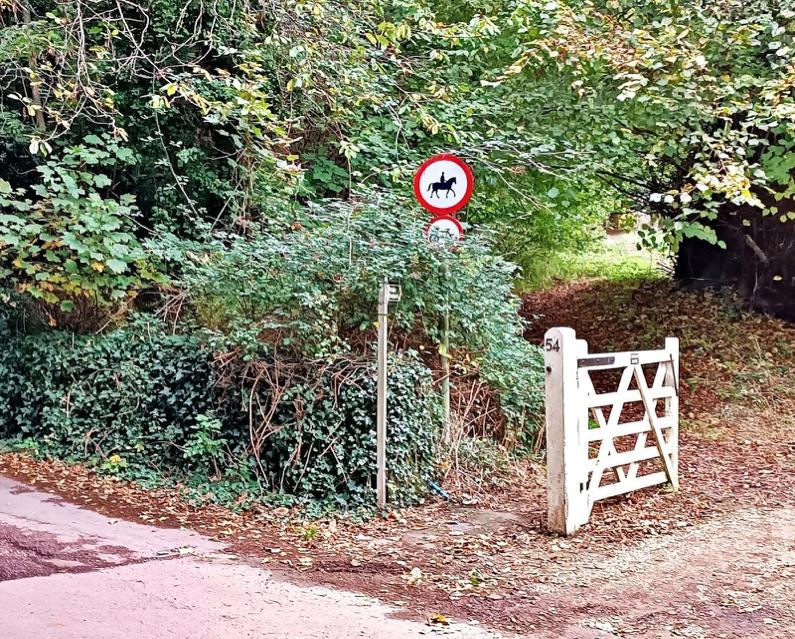
8 Aldgate
Turn left at the T-junction.
At the end of Aldgate is a farm to the right. A footpath to the right before the footbridge joins the Blue Walk along the bank of the River Chater, and across an ancient ridge and furrow field.
9 Sinc Stream
Cross the footbridge over the River Chater and walk alongside Sinc Stream.
The track used to end with a ford across the River Chater. Sinc Stream is now managed for its biodiversity value as a rare calcareous stream. The stream is fed by a spring that once formed one of the main sources of water for the village. Washing water from a laundry at St Mary’s House in the High Street and a slaughterhouse used to pass down Sinc Stream, perhaps originally named stink stream! On the left is Hall Close with its old apple orchard by the riverside and the spinney of Cappadocian Maple which used to be an osier bed for making willow baskets. There was an ancient hall called Hall Gate in Hall Close. This gave the name Aldgate as a misnomer.

10 Bull Lane
Continue along the tarmac path to the end of Sinc Stream which then becomes Bull Lane.
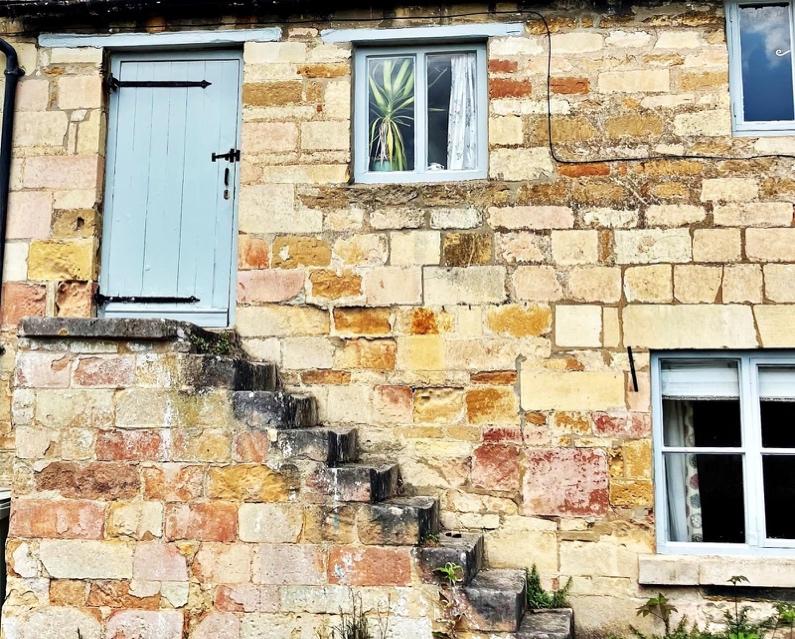
Just before the Wesleyan Methodist Chapel on the right there was a pipe for spring water with steps down for villagers to collect water. The chapel was built in 1864 and the adjacent Methodist Hall in 1960. Ketton was notable for its nonconformist chapels, including: Congregational, Dissentient Methodist, Primitive Methodist, and Wesleyan Methodist. One of two blacksmiths’ forges in the village was at the end of the lane. Bull Lane bakery, with its stone steps leading to a granary, was the last of three village bakeries. Bull Lane gets its name from the Pied Bull Inn which stood on the site of a small filling station by the main road. The Barley Mow Inn was another one of the nine village inns to close in the 20th century.
11 Ketton Shop and Post Office
Turn left at the main road (A6121) to cross the zebra crossing close to the shop and then left down the High Street.
One of the pair of cottages before the shop has an inscribed plaque recording the appreciation of some Belgian refugees who lived in the cottage during the First World War. The name Ketton was filled in on the inscription during the Second World War, as a security measure so that any passing German invader would not readily discover which village he was in! A new housing development on the site of the former Home Farm has converted some fine stone barns and one of the three dovecotes in the village. There were at least three working farms along the High Street from here to the Ketton Hub.

12 St Mary’s House
Continue to St Mary’s House just after Hunt’s Lane.
St Mary’s House was established in 1892 as Saint Mary’s Diocesan Home. This Home for “fallen women housed twenty-two girls and after two or more years sent them out, restored in health of body and soul.” The Home, run by Anglican nuns, operated a laundry in the rear of the premises to help with the girls’ re-education, and offset some of the running costs of the institution. It was said that if one of the girls escaped a bell was rung to alert the villagers to help in her return. The Home was closed in 1944 as running costs rose and the moral climate changed.
13 The Design House
Continue along the High Street to see the Design House on the other side of the road.
The Design House was the former Ketton Club and before that a tall barn. Near here is where the famous inter village game of quoits was last played. Mr Arthur Knox of Ketton was three times national champion from 1928-1931. The heavy quoit, made of cast iron, was thrown over fifty feet onto pins in a clay bed, and there were several such beds in Ketton. The Yewtrees was formerly a farmhouse with some of the farm buildings on the opposite side of the road.
14 Pelican Crossing
Continue along the High Street to the pelican crossing to return safely to the Ketton Hub.
Opposite the school entrance are some old cottages where the floor level is lower than the level of the High Street as an indication of their age. The pelican crossing leads back to the Hub and Library. Further along the High Street at the crossroads is Hibbins House. It was built by the Hibbins family in the late 19th century and has some remarkable carved stonework – grotesque gargoyles, finials and crockets, all demonstrating the master mason’s craft.
